
I have been following the case of Sarah Murnaghan, a dying 10-year-old girl who, after a federal judge granted her family’s emergency petition, has become eligible to seek donor lungs from an adult transplant list. In the petition, Sarah’s family challenged the organ transplant rules that require children under 12 to wait for pediatric lungs, pointing out in their request that pediatric lungs rarely become available, and that some children, like Sarah, may be candidates to receive adult ones.
In monitoring the story, I have been moved by the Murnaghan family’s activism, challenged to think deeply about the medical and ethical issues surrounding organ transplants, and appalled (yet again) by the demagoguery of politicians and pundits who have used this child’s desperate situation to raise their own visibility. (For them I have this message: “Do us all a favor, and put a sock in it.”)
It may very well be time to change the rules governing organ-transplant waiting lists — but doing only that would not be the magic bullet for patients who need organs. The sad facts are that, nationally, there are approximately 118,000 people currently awaiting organ donations. Of those, 1,700 people need lungs, including 31 children ages 10 and younger. And as is displayed in the following graph, for desperately ill people like little Sarah, waiting time can be deadly.
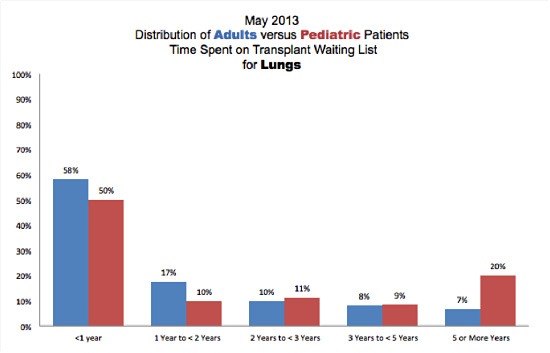
U.S. Department of Health and Human Services Organ Procurement
and Transplant Network (OPTN)
Why are the wait times so long for some patients? Quite simply, in sharp contrast to the number of people who need lungs is the scarcity of donated ones.
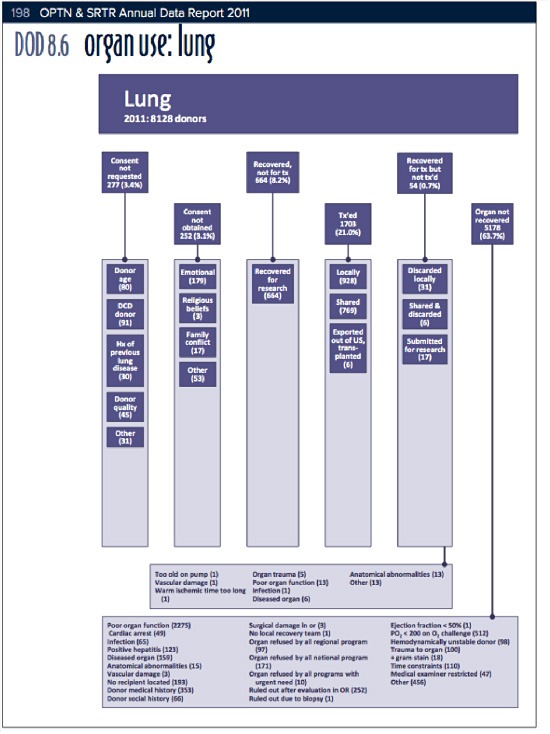
As displayed in this diagram from the 2011 OPTN & SRTR Annual Data Report, of the 8,128 lung donations, only 21% (1,700) of them could be transplanted.
(Note: some were given to patients requiring multiple organs, thereby reducing the number of lungs available for patients on the lung-only list even more.)
The diagram and the accompanying notes make it clear how many clinical reasons there are for the fact that almost 80% of these lungs were not transplanted. Perhaps there is not much to be done about that (aside from encouraging future donors to take care of their health — which, if you think about it, is both good advice and somewhat bizarre). There is however something we can do about the total number of organs available: increase the number of donors. Inspired by the data (and the idea, attributed to Mahatma Gandhi, that the world will mirror the changes we make in ourselves), I have registered to be a living and deceased donor. (I will however say in full disclosure that I am planning to live past the deceased donor cutoff age of 80, so that while my intentions are good, my follow-through on that front will, I sincerely hope, be a total bust.)
Now perhaps it’s your turn. I invite you to consider becoming a donor. Hey, if you plan to outlive your potential usefulness in that sphere, as I do, then it’s a pretty painless choice, right? Check out all the information here: www.TheNationalNetworkofOrganDonors.org.
Bottom line: we know from the data that until the scarcity of organs is addressed, we are only tinkering around the edges of the problem — because if there are not enough organs for everyone who needs them, the only fair way to distribute them is rationing using currently available clinical evidence about which patients have the best chance of receiving successful transplants. If rationing organs this way is not acceptable to us, then we need more organs.
It is way past time to quit with the rhetoric, and follow the data.

Leave a Reply